
Taco Night Costs Are Up 19%: Here's What's Driving Grocery Prices Higher
Grocery prices are still climbing, and for budget-conscious shoppers, what you're putting in your cart matters more than ever. After digging into federal pricing data for 25 everyday staples, it's clear that proteins and beverages are leading the surge, while some pantry basics have actually gotten cheaper. Knowing where prices are rising and where they're falling can make a real difference at checkout.
Key Takeaways
- A pound of ground roast coffee costs $9.46 today, up 55% from $6.09 in February 2024, making it the fastest-rising grocery staple tracked in this study.
- A homemade taco night for a family of four costs $24.65 in ingredients, up 19% from $20.79 two years ago and 41% from $17.50 in February 2020.
- Ground beef hit $6.74 per pound in February 2026, a 31% increase from $5.13 in February 2024 and 74% above its pre-pandemic price of $3.87.
- 11 of 25 common grocery staples actually dropped in price over the past 2 years, led by eggs (-17%), potatoes (-11%), and tomatoes (-11%), but the items still climbing are rising fast enough to offset those declines.
Grocery Price Swings Are Splitting the Cart
Not every item on your grocery list is getting more expensive at the same rate. The biggest jumps are concentrated in proteins and beverages, while pantry staples are quietly offering some of the best relief shoppers have seen in years.
https://public.flourish.studio/visualisation/28099833/
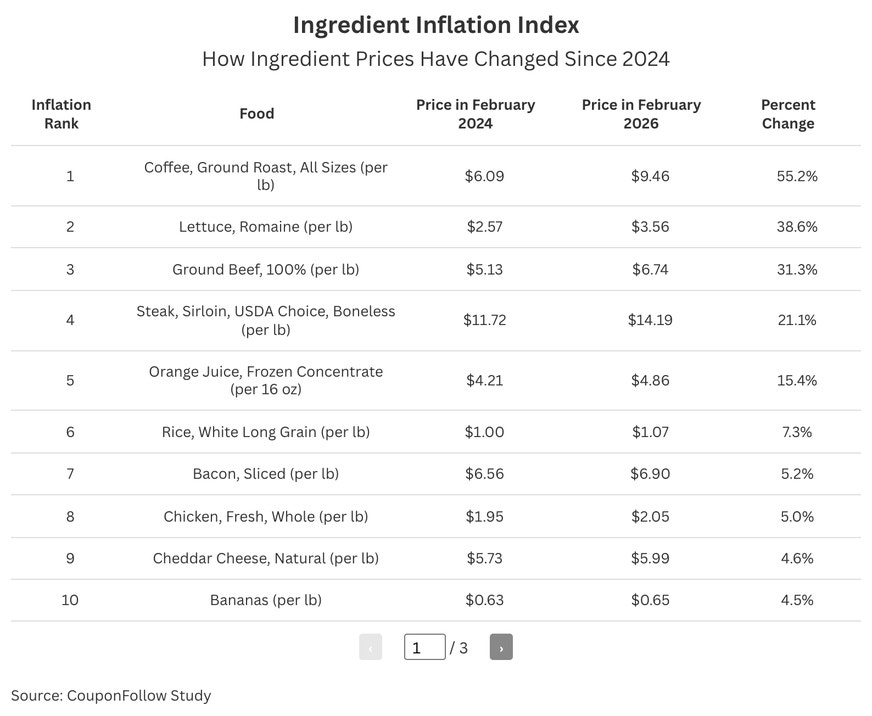
- 14 of 25 tracked grocery items rose in price from February 2024 to February 2026, with the 5 largest increases all coming from: coffee (+55%), lettuce (+39%), ground beef (+31%), sirloin steak (+21%), and orange juice (+15%).
- Eggs saw the largest decline of any item, down 17%, but they still cost 73% more than their February 2020 price.
- A pound of ground roast coffee saw a 123% increase since February 2020 and a 55% increase since February 2024. That makes it the highest-inflating grocery item over the full 6-year window.
- Pantry staples are where consumers are finding relief: white bread (-8%), spaghetti (-8%), butter (-7%), and flour (-2%) all declined from their February 2024 prices.
What You Cook Now Determines Your Grocery Bill
The meals you make each week are now one of the biggest factors in how much grocery inflation you absorb. A protein-heavy dinner like taco night tells a very different story than a breakfast built around bread and eggs.
https://public.flourish.studio/visualisation/28100011/
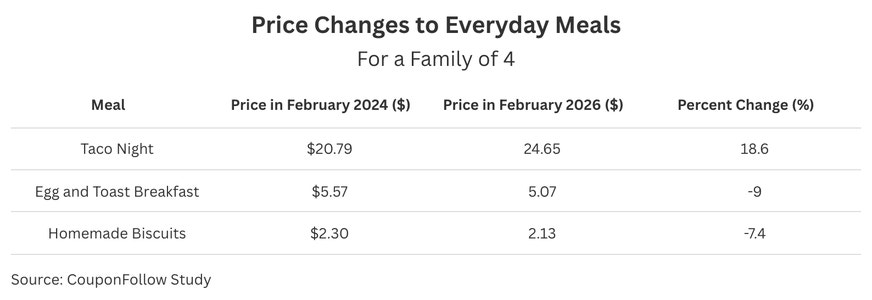
- Taco night is the only meal of the three in this study that got more expensive over the past 2 years, rising 19%, with ground beef alone accounting for $3.22 of the $3.86 total increase.
- An eggs-and-toast breakfast for a family of 4 costs $5.07 today, down 9% from its price in February 2024. But that same breakfast hit $7.48 in February 2025 at the peak of the avian flu egg crisis.
- A batch of homemade biscuits costs $2.13 in ingredients, down 7% from February 2024, and is the most affordable and most stable meal tracked in the study.
- All three meals remain 27% to 41% more expensive than they were in February 2020, even as 2 of the 3 have dipped from their 2024 levels.
- The protein-heavy meal (taco night) saw a 19% cost increase, while the pantry-staple meals (breakfast, baking) both declined, showing that what a family chooses to cook now directly determines how much grocery inflation they absorb.
Start Saving at the Grocery Store
Grocery inflation isn't going away overnight, but small changes to how and where you shop can add up fast. Paying attention to which categories are rising and which are cooling, stocking up on pantry staples when prices dip, and being flexible with pricier proteins are all easy ways to stretch your grocery budget a little further. Stacking those habits with coupons and deals can make an even bigger dent in your weekly bill.
Methodology
For this study, we leveraged the U.S. Bureau of Labor Statistics Consumer Price Index Average Retail Food Price tables, accessed via the Federal Reserve Economic Data (FRED) database. We reported the price changes of 25 items, specifically the average retail price paid by urban consumers across U.S. cities, not seasonally adjusted.
The Composite Ingredient Inflation Index is the simple average of the percentage change across all 25 tracked items from February 2024 to February 2026 and February 2020 (pre-pandemic) to February 2026. Items are ranked by percentage increase. This is an equal-weighted basket, not adjusted for household spending patterns.
Three meal scenarios translate item prices into relatable household costs:
- Taco Night (family of 4): 2 lbs ground beef, ½ lb cheddar cheese, 2 lbs tomatoes, 1 lb romaine lettuce, 1½ lbs flour
- Eggs & Toast Breakfast (family of 4): ⅔ dozen eggs, 1 lb white bread, 2 tbsp butter, 4 glasses of milk
- Homemade Biscuits: 2½ cups flour, ½ cup butter, 1 cup milk, 2 eggs
Meal costs are calculated by multiplying each ingredient's BLS unit price by the quantity required. These totals do not include non-BLS items such as cooking oil, spices, or condiments, and therefore represent a conservative estimate of the true meal cost.
About CouponFollow
At CouponFollow, we help savvy shoppers save money with the latest discount codes and deals, all in one place. We also dig into consumer spending trends to bring you trustworthy, real-world insights like the grocery price data you see above. When prices are rising, every little bit helps, so browse our latest coupons and deals and start saving today.
Fair Use Statement
This content is provided for noncommercial use only. Please include proper attribution with a link back to CouponFollow when you share it.
About The Author

Senior Trends Analyst
As an e-commerce analyst at CouponFollow, Clay enjoys spending his time collaborating with brands to make helpful content for consumers and finding great deals to share on CouponFollow. As a recent college graduate, his primary focus is creating resources for consumers, especially students, to save money through online shopping and everyday life.